For over four decades, retinol has held an unchallenged spot as the gold standard of dermatological anti-aging. From clearing stubborn adult breakouts to smoothing fine expression lines, vitamin A derivatives have proven clinical results.
However, modern skincare is experiencing a major shift. Skincare enthusiasts are growing tired of the endless cycle of peeling, redness, barrier breakdown, and heightened sun sensitivity that often comes with retinoid use.
Enter Copper Peptides (specifically GHK-Cu): the restorative powerhouse taking dermatology and clean beauty by storm.
Can a gentle blue peptide serum rival the wrinkle-smoothing power of retinol? Can you use both in the same routine, or do they cancel each other out?
Here is the scientific breakdown to help you choose the best active for your skin.
Understanding Retinol: The Cellular Turnover Accelerator
Retinol belongs to the retinoid family—compounds derived from Vitamin A. When applied to the skin, retinol undergoes a two-step enzymatic conversion:
- Retinol converts to Retinaldehyde (Retinal).
- Retinaldehyde converts to Retinoic Acid (the active molecule that interacts directly with cellular DNA).
How Retinol Works in the Dermis: Retinoic acid binds to nuclear retinoic acid receptors (RAR) within skin cells, signaling them to act younger and divide faster:
- Speeds Epidermal Turnover: It accelerates the shedding of old, dull surface cells, pushing fresh cells to the surface.
- Clears Follicular Congestion: By keeping cell turnover moving, it prevents sebum and keratin plugs from forming comedones.
- Inhibits Collagenase: It stops the activity of matrix metalloproteinases (MMPs)—enzymes that break down existing collagen under UV light.
- Evens Out Melanin: It breaks up stubborn clusters of hyperpigmentation, melasma, and post-acne dark marks.
The Trade-Offs of Retinol: Because retinol forces rapid surface turnover, it often leads to retinoid dermatitis:
- Flaking, peeling, and dryness around the mouth and nose.
- Increased photosensitivity, leaving skin vulnerable to sunburn.
- Impaired barrier function that can trigger rebound sensitivity.
- It is strictly contraindicated during pregnancy and breastfeeding.
Understanding Copper Peptides: The Dermal Architecture Restorer
Copper Tripeptide-1 (chemically known as GHK-Cu) is a naturally occurring complex of three amino acids (glycyl-histidyl-lysine) bound to a copper(II) ion. First isolated from human plasma by Dr. Loren Pickart in 1973, GHK-Cu is an innate healing peptide that declines significantly as we age.
By age 60, plasma levels of GHK-Cu drop by more than 60%, contributing to thinner skin, slower wound healing, and reduced collagen production.
How Copper Peptides Rebuild Skin: Unlike retinol, which accelerates shedding from the top down, copper peptides work from the bottom up as signaling molecules:
- Stimulates Collagen I, III, and IV: GHK-Cu signals fibroblasts to produce structural collagen, which provides tensile strength, as well as fine reticular collagen, which restores youthful firmness.
- Boosts Elastin Synthesis: While retinol primarily impacts collagen, copper peptides also stimulate elastin fibers, restoring bounce and firmness to sagging skin.
- Increases Glycosaminoglycans (GAGs): They trigger the synthesis of natural hyaluronic acid and chondroitin sulfate within the dermal matrix, plumping the skin from within.
- Potent Antioxidant & Anti-Inflammatory Action: Copper is a vital cofactor for Superoxide Dismutase (SOD)—one of your body’s strongest antioxidant defense systems. It neutralizes free radicals while calming underlying inflammation.
The Big Advantage: Copper peptides rebuild the skin without thinning the stratum corneum, causing peeling, or triggering sun sensitivity.
Head-to-Head Comparison: Retinol vs. Copper Peptides
- Primary Mechanism:
- Retinol: Cellular turnover & surface exfoliation
- Copper Peptides: Fibroblast signaling & tissue repair
- Collagen Synthesis:
- Retinol: High (Mainly Type I)
- Copper Peptides: Very High (Types I, III, IV, & VII)
- Elastin & Firmness:
- Retinol: Moderate
- Copper Peptides: Exceptional
- Irritation & Peeling Risk:
- Retinol: High (Requires gradual acclimation)
- Copper Peptides: Near Zero (Soothes the barrier)
- Photosensitivity:
- Retinol: Increases sun sensitivity (Night only)
- Copper Peptides: Non-phototoxic (Safe for daytime use)
- Pigmentation & Melasma:
- Retinol: Superior for stubborn dark marks
- Copper Peptides: Moderate (Fades redness & post-acne marks)
- Average Price Point:
- Retinol: Accessible to Moderate
- Copper Peptides: Premium (Complex peptide synthesis)
Which One Should You Choose?
Choose Copper Peptides If:
- You have sensitive, dry, thin, or rosacea-prone skin that reacts poorly to exfoliants.
- Your primary cosmetic concern is skin laxity, loss of firmness, and fine lines, rather than surface texture.
- You spend time outdoors and want an anti-aging serum you can safely wear under morning sunscreen.
- You want to maintain a strong, resilient skin barrier without going through a purge phase.
Choose Retinol If:
- Your main concerns are rough surface texture, large clogged pores, and adult hormonal breakouts.
- You struggle with deep hyperpigmentation, stubborn sun spots, or melasma.
- Your skin barrier is healthy, resilient, and tolerates active resurfacing agents well.
Can You Use Both? (The Smart “Skin Cycling” Strategy)
You do not have to choose just one. You can use both actives to enjoy the benefits of cellular turnover and structural repair.
Crucial Rule: Never layer copper peptides directly on top of retinol in the same application. The acidic nature of certain retinoid formulations can destabilize the copper complex, oxidizing the peptide and neutralizing both products.
The 4-Night Synergistic Routine:
- Night 1 (Turnover): Gentle cleanse, followed by Retinol serum and a Ceramide moisturizer.
- Night 2 (Recovery & Rebuild): Gentle cleanse, followed by Copper Peptide serum and a nourishing lipid barrier cream.
- Night 3 (Recovery & Rebuild): Gentle cleanse, followed by Copper Peptide serum and a barrier repair balm.
- Night 4 (Deep Hydration): Gentle cleanse, followed by a soothing panthenol & cica essence, sealed with squalane oil.
- Every Morning: Gentle rinse, followed by Copper Peptide serum, a light moisturizer, and broad-spectrum Mineral SPF 50+.
Skincare Ingredients That Clash with Copper Peptides
To protect your investment in copper peptide serums, keep them separate from these common actives:
- Pure L-Ascorbic Acid (Vitamin C): Low-pH ascorbic acid cleaves the copper bond. The free copper ion can oxidize the Vitamin C, turning it orange and neutralizing both formulas. (Solution: Use Vitamin C in the morning and Copper Peptides at night, or use a gentle, non-acidic Vitamin C derivative like Tetrahexyldecyl Ascorbate).
- Direct Alpha & Beta Hydroxy Acids (AHA/BHA): High-concentration glycolic, lactic, and salicylic acids create an acidic environment that breaks down peptide bonds. (Solution: Keep chemical exfoliants to separate nights).
Frequently Asked Questions (FAQ)
How long does it take to see results from copper peptides? While surface hydration improves within days, structural firming, improved elasticity, and smoothed fine lines typically become visible between 8 to 12 weeks of consistent daily application, as new collagen fibers mature.
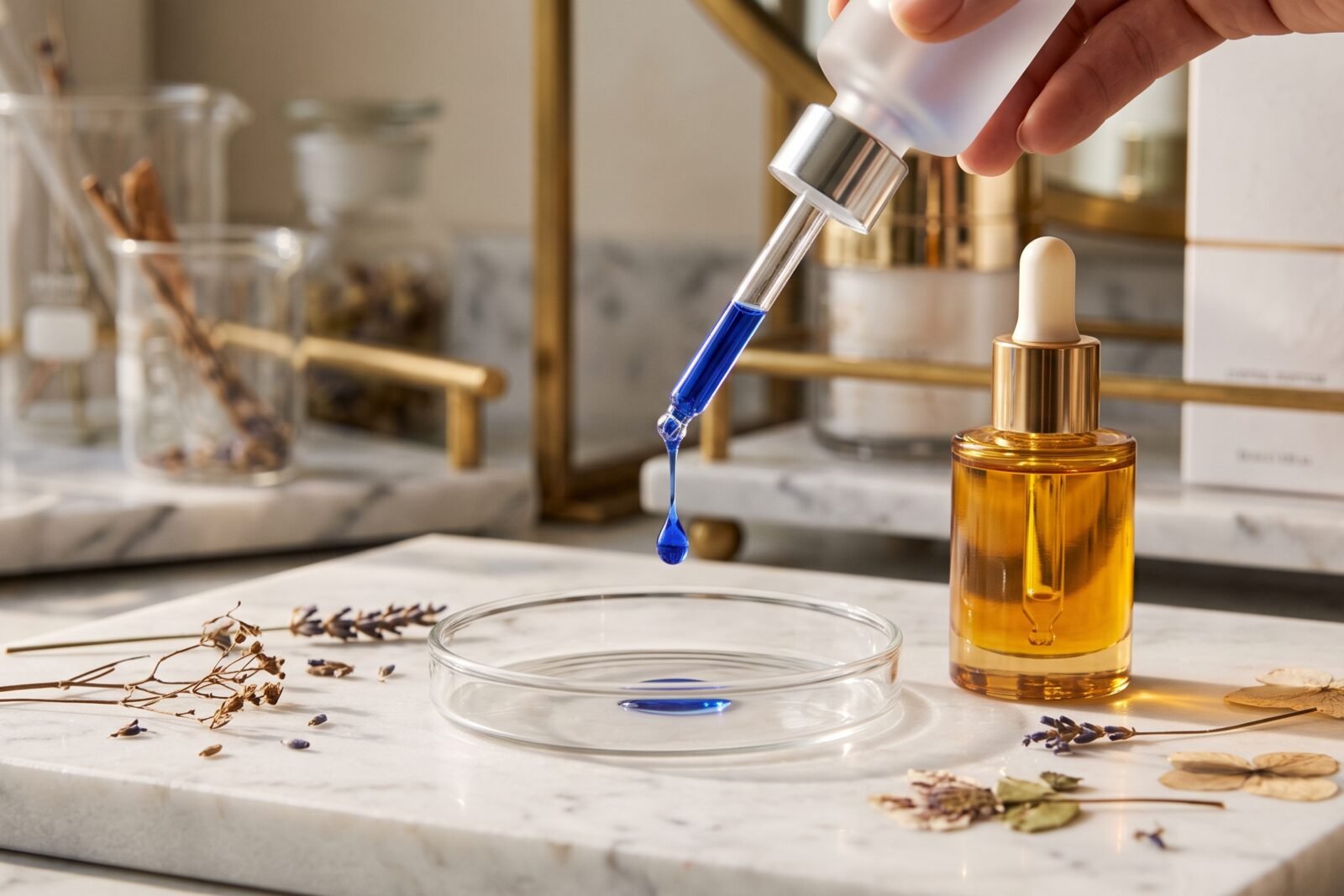
What causes the bright blue color of copper peptide serums? The vibrant blue color comes naturally from the copper(II) ion binding to the tripeptide chain. If a copper peptide serum is clear or pale yellow, it either contains no real GHK-Cu or uses an ineffective micro-dose.
Can I use copper peptides with Niacinamide? Yes! Niacinamide and copper peptides work harmoniously together. Niacinamide supports lipid barrier synthesis and pore clarity, while copper peptides stimulate structural collagen.