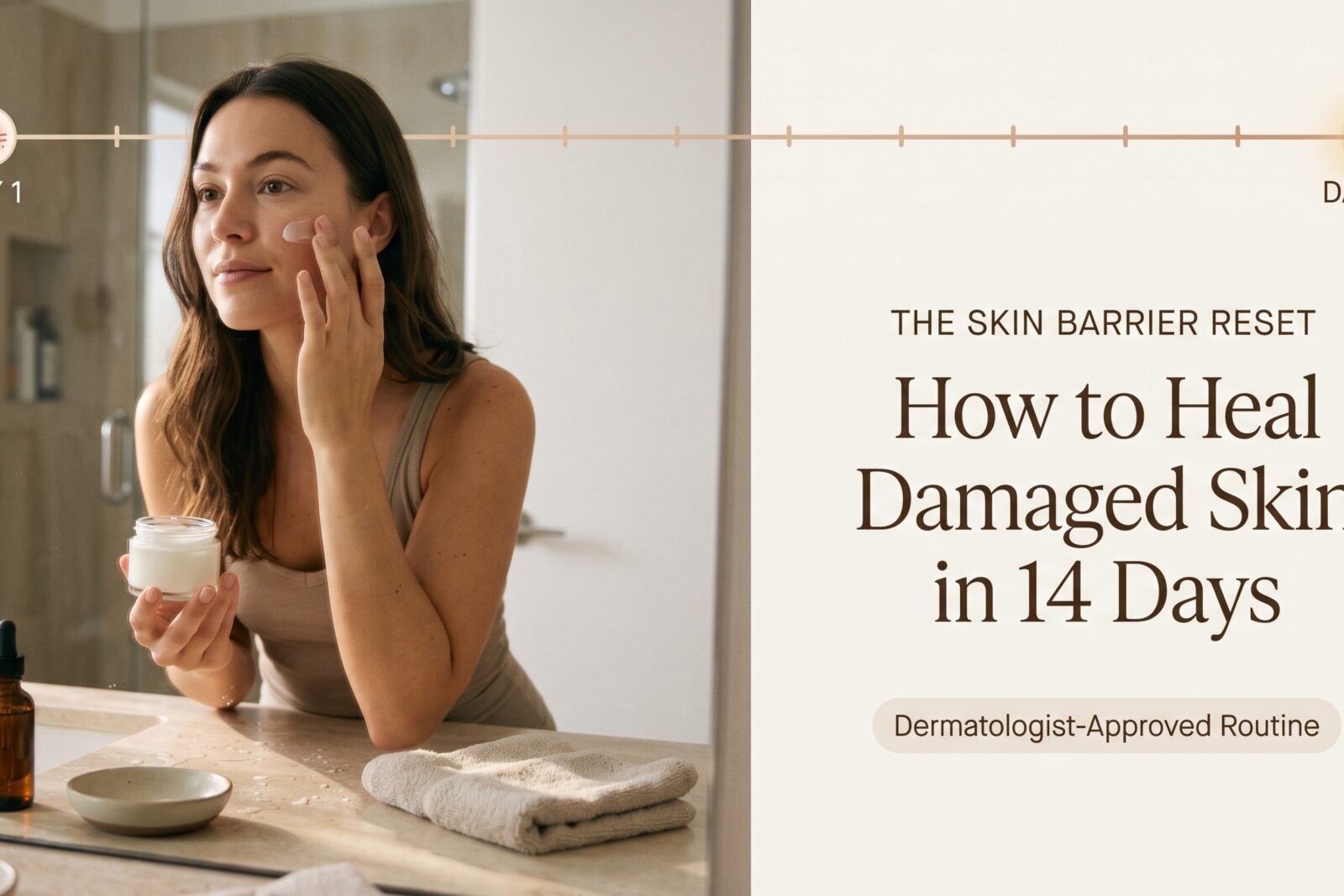
If splashing plain water on your face burns, if your foundation sits in flaky patches despite applying heavy oils, or if your complexion feels simultaneously tight, oily, and constantly inflamed, your skin is sending an urgent distress signal.
You do not need a stronger clarifying scrub or another concentrated acid peel. Your skin barrier is compromised.
In our collective pursuit of instant “glass skin” and poreless perfection, millions of skincare enthusiasts have fallen victim to the over-exfoliation trap. We cocktail multi-acid serums, use prescription retinoids without proper barrier buffering, cleanse with high-pH foaming surfactants, and wonder why our skin looks dull, red, and irritated.
The good news? Your skin barrier possesses a remarkable biological capacity for regeneration. When you eliminate underlying aggressors and supply your epidermis with the exact physiological lipid building blocks it needs, you can repair years of damage in as little as 14 days.
In this comprehensive, dermatologist-backed guide, you will learn the exact biological mechanics of your skin barrier, the critical mistakes to halt immediately, and a day-by-day protocol to bring your complexion back to radiant health.
What Exactly Is the Skin Barrier? (The Science of the Stratum Corneum)
To fix a broken barrier, you must first understand how it is built.
Dermatologists frequently describe the stratum corneum—the outermost layer of your epidermis—using the “brick and mortar” model:
- The Bricks (Corneocytes): These are tough, flattened cellular protein envelopes filled with keratin and water-binding natural moisturizing factors (NMF).
- The Mortar (Intercellular Lipid Matrix): This continuous lipid matrix fills the gaps between corneocytes. It is composed of a very specific biological ratio:
- 50% Ceramides (Lipid molecules that hold moisture and prevent permeability).
- 25% Cholesterol (Maintains membrane fluidity and elasticity).
- 15% Free Fatty Acids (Creates the protective acid mantle and regulates pH).
When this lipid mortar is intact, it fulfills two essential biological functions:
- It locks vital hydration inside, keeping trans-epidermal water loss (TEWL) to an absolute minimum.
- It keeps environmental pathogens outside, deflecting allergens, air pollution, irritants, and bad bacteria that trigger inflammation.
When that lipid mortar degrades, micro-tears develop across the surface. Water escapes rapidly into the air, and airborne irritants penetrate deep into living cellular tissue. The result is chronic low-grade inflammation, persistent redness, and a compromised immune defense that leads to reactive breakouts.
7 Telltale Signs Your Skin Barrier Is Damaged
How do you know if you are dealing with ordinary sensitive skin or a truly broken barrier? Look for these unmistakable clinical indicators:
- The “Water Sting”: Applying neutral, gentle moisturizers or even lukewarm tap water triggers an immediate prickling or burning sensation.
- The Shiny, Tight Illusion: Your skin looks unnaturally tight, shiny, and plastic-like across the forehead and cheekbones, yet it feels parched and feels like it might crack when you smile.
- Midday Paradox (Flaky Yet Greasy): Your skin produces excess midday oil to compensate for moisture loss, while visible dry flakes peel around the nose, mouth, and brows.
- Sudden, Mystery Breakouts: Tiny, red, rash-like pustules cluster in areas where you rarely had blemishes before.
- Chronic Flushing and Erythema: Your cheeks turn bright pink or crimson from mild temperature shifts, light exercise, or standard skincare application.
- Rough, Sandpaper-Like Texture: Microscopic flaking creates a coarse, uneven surface that makes makeup cling and pill instantly.
- Loss of Skin Bounce and Elasticity: Dehydrated corneocytes collapse, causing shallow dehydration lines that can be mistaken for premature fine wrinkles.
The 4 Biggest Culprits Behind Barrier Breakdown
Before you can begin healing, you must stop the habits causing the breakdown. The vast majority of barrier damage comes from four routine missteps:
- Over-Exfoliation and Chemical Acid Stacking: Using glycolic acid toners in the morning followed by salicylic acid serums at night and an enzyme mask on weekends strips away lipid layers faster than your fibroblasts can produce new ones.
- High-pH Cleansers and Sulfates: Healthy skin has an acidic mantle with an optimal pH of 4.5 to 5.5. Traditional bar soaps and harsh foaming cleansers often carry an alkaline pH of 7.0 to 9.0. Washing with alkaline products degrades the acid mantle, neutralizes the skin’s natural protective enzymes, and dissolves essential intercellular ceramides.
- Mismanaging Retinoids (The “Tretinoin Burn”): Jumping straight into daily prescription tretinoin or high-strength retinol without gradually titrating frequency or using the “sandwich method” causes acute retinoid dermatitis.
- Excessive Hot Water and Physical Friction: Scalding hot showers strip away the skin’s natural sebum, while physical face scrubs and rough cotton washcloths create micro-fissures in fragile, thinning epidermal tissue.
The 14-Day Day-by-Day Reset Protocol
Here is the structured 3-phase protocol to systematically rebuild your barrier from the ground up:
Phase 1 (Days 1 to 4): The Elimination Protocol
Your sole priority during these first four days is to halt ongoing chemical irritation and stop trans-epidermal water loss.
Morning Ritual:
- Cleanse: Do not use any cleanser. Rinse your face with cool or tepid water only.
- Treat: Do not apply vitamin C, niacinamide above 2%, or exfoliating toners.
- Moisturize: Apply a rich, unscented barrier cream containing Ceramides NP, AP, and EOP directly to damp skin.
- Protect: Finish with a 100% pure mineral sunscreen based on non-nano Zinc Oxide. Zinc oxide acts as an innate anti-inflammatory agent while shielding vulnerable skin from UV radiation.
Evening Ritual:
- First Cleanse: If wearing mineral SPF, gently melt it away with a fragrance-free, oat-infused cleansing balm or squalane oil.
- Second Cleanse: Wash with a non-foaming, milk or lotion cleanser that contains glycerin and colloidal oatmeal. Pat dry very gently with a clean microfiber towel—never rub.
- Repair: Smooth on a generous layer of ceramide cream. If your skin is stinging, layer pure 100% plant-derived squalane oil directly on top.
Phase 2 (Days 5 to 9): Deep Cellular Replenishment
By day five, active stinging will diminish. Now is the time to restore internal hydration reserves and support cellular repair.
What to Add:
- Skin-Mimicking Humectants: Introduce Beta-Glucan or Panthenol (Pro-Vitamin B5). Beta-glucan binds 20% more moisture than hyaluronic acid, penetrates deeply into the dermis, and accelerates wound healing.
- Centella Asiatica (Cica / Madecassoside): A traditional botanical used in medical wound healing, Cica dampens inflammatory cytokines and stimulates type-I collagen synthesis.
- Application Technique: Never apply humectants to bone-dry skin in air-conditioned or heated rooms, or they will pull moisture upward from your deeper dermis. Always mist with pure thermal water first, then pat your soothing essence in immediately.
Phase 3 (Days 10 to 14): Structural Fortification & The “Micro-Slug”
In this final phase, you fortify the newly repaired lipid matrix and lock in hydration to prevent future breakdown.
The Evening “Micro-Slug” Technique: Slugging involves sealing your nighttime skincare with a thin layer of a petrolatum-based or plant-wax occlusive ointment:
- Petrolatum reduces trans-epidermal water loss by up to 99%, creating an optimal micro-environment for cellular repair.
- How to Micro-Slug: After applying your ceramide barrier moisturizer, warm a pea-sized amount of pure pharmaceutical ointment or an organic multi-lipid balm between your palms and press it gently across your cheeks, temples, and neck.
- Note for Acne-Prone Skin: If you have active cystic acne, avoid pure petrolatum. Instead, use pure jojoba or squalane oil, which mimic natural sebum without trapping excess follicular bacteria.
Ingredients to Look For vs. Ingredients to Avoid
Healing Ingredients to Seek:
- Ceramides (NP, AP, EOP)
- Colloidal Oatmeal (1–2%)
- Panthenol (Pro-Vitamin B5)
- Ectoin
- Bifida Ferment Lysate
- Pure Squalane Oil
Irritating Ingredients to Avoid:
- Glycolic, Lactic, and Mandelic Acid
- Salicylic Acid (BHA) & Benzoyl Peroxide
- Synthetic Fragrance & Essential Oils (Lavender, Citrus)
- Denatured Alcohol (Alcohol Denat / Isopropyl)
- Physical Walnut/Apricot Scrubs
- High-strength Vitamin C (L-Ascorbic Acid > 10%)
3 Critical Barrier Repair Mistakes to Avoid
- Slugging Over Active Resurfacing Ingredients: Never apply an occlusive slugging balm on top of retinol, AHAs, or BHAs. The occlusive layer traps the active ingredients against your skin, multiplying their potency and causing deep chemical burns.
- Rushing Back into Daily Retinol: When your skin feels soft and calm on Day 14, do not jump straight back into daily strong actives. Wait until Day 16, and reintroduce retinol only once or twice per week, buffering it between two layers of moisturizer.
- Skipping Sunscreen on Overcast Days: Compromised stratum corneum lets UVA rays penetrate directly to fragile basal cells. Daily broad-spectrum SPF 30+ is essential throughout your recovery.
Frequently Asked Questions (FAQ)
How can I tell when my skin barrier is completely healed? Your barrier is restored when lukewarm water and basic moisturizers no longer cause any stinging, midday tightness is gone, surface redness fades to a calm, even tone, and your complexion holds hydration from morning to night.
Can I wear makeup while repairing my skin barrier? It is best to pause heavy matte foundations and setting powders during the first 7 days, as they often contain drying alcohols. If you need coverage, opt for a zinc-based tinted mineral SPF or a clean, squalane-based serum tint.
Will hyaluronic acid heal my broken skin barrier? Not on its own. While hyaluronic acid is a popular humectant, if used in dry climates without a proper occlusive layer, it can draw moisture out of deeper dermal layers, making dryness worse. Prioritize ceramides, ectoin, and beta-glucan instead.