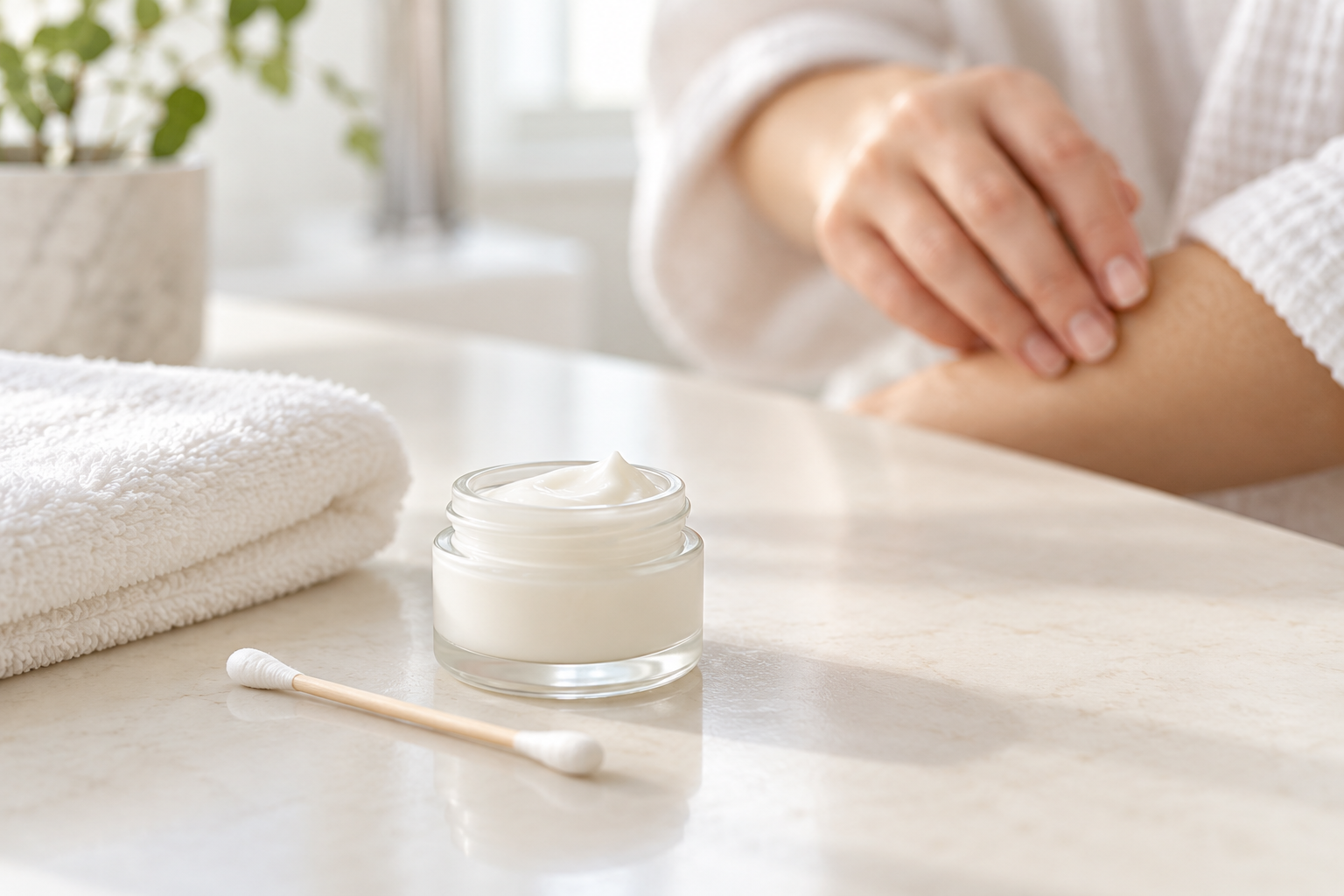
Trying a new cleanser, moisturizer, or serum can feel like a gamble if you are unsure how your skin will respond. The American Academy of Dermatology (AAD) recommends testing a skincare product on a small area before adding it to your routine. This at-home use test may help you notice a reaction, but it cannot guarantee that a product will never irritate you or diagnose an allergy.
Below is the AAD’s general approach, what to do if your skin reacts, and how an at-home product test differs from medical allergy testing.
How to test a skincare product at home
The AAD recommends applying a small amount of the product to a test spot twice a day for 7 to 10 days. A quarter-sized area on the underside of your arm or the bend of your elbow is one option. Use the product as you normally would, including leaving it on for the usual time.
If the product is normally rinsed off, such as a cleanser, leave it on the test spot for five minutes or for the amount of time stated in its directions, then rinse it off. Do not apply it to broken or irritated skin. Follow the product label, and do not test a product on an area where it is not intended to be used.
Watch for a reaction such as redness, itching, or swelling. If you develop a reaction, gently wash the product off and do not use it again. If a reaction is severe, persists, or worries you, contact a healthcare professional. The AAD notes that a dermatologist can help if it is difficult to identify which ingredient caused irritation.
What an at-home test can and cannot tell you
A small-area test is a practical precaution before routine use, but a clear test spot does not guarantee you will never react when using the product more broadly or over time. Your face may respond differently than your arm, and reactions can have different causes.
An at-home use test also is not the same as medical patch testing. Medical patch testing is performed and interpreted by a healthcare provider to investigate allergic contact dermatitis and identify possible allergens. If you have recurring reactions or suspect an allergy, ask a dermatologist or other qualified healthcare professional about appropriate testing instead of trying to diagnose the cause yourself.
How to test products without confusing the results
- Test one new product at a time when practical.
- Keep the rest of your routine stable during the test period.
- Use the product according to its directions, including how long it stays on the skin.
- Make a note of the product name, start date, and any changes you notice.
- Stop using it if a reaction develops, and do not keep applying it to “build tolerance” unless a clinician specifically advises you to do so.
If the package includes specific safety directions, follow those. Some ingredients, including retinol and glycolic acid, may cause irritation for some people; this is not a reason to ignore a strong or persistent reaction. Seek qualified guidance if you are unsure what you are experiencing.
What if my skin reacts?
The AAD advises gently washing the product off as soon as possible and not using it again if you develop a reaction. It suggests a cool compress or petroleum jelly may help with a mild reaction. If symptoms are severe or do not improve, contact a dermatologist or another qualified healthcare professional.
Get urgent medical care for symptoms that feel severe or rapidly worsen, especially trouble breathing or swelling of the lips, tongue, or face. Do not rely on an article or product review to assess a serious reaction.
Frequently asked questions
How long should I patch test a skincare product?
The AAD recommends testing a product twice daily for 7 to 10 days on a small spot of skin. Follow the product directions, particularly for rinse-off products.
Where should I test a new face cream?
The AAD suggests a quarter-sized spot on the underside of the arm or bend of the elbow. Avoid broken or already irritated skin, and follow the directions for the product you are testing.
Does a negative patch test mean I cannot be allergic?
No. An at-home product test is not a medical allergy test and cannot guarantee that a reaction will never happen. If you have recurring reactions, a healthcare professional can assess whether medical testing is appropriate.
Should I test every new skincare product?
The AAD recommends testing skincare products before adding them to your routine. This is particularly useful when introducing a product you have not used before, but it is not a guarantee against all reactions.
The takeaway
Test a new skincare product on a small area first, follow its directions, and watch for changes over the AAD’s recommended 7 to 10 day period. Stop if a reaction appears. For recurring, severe, or unclear symptoms, ask a qualified healthcare professional; a home test cannot diagnose an allergy.
Sources and further reading
- American Academy of Dermatology Association, How to test skin care products
- U.S. Food and Drug Administration, Allergens in Cosmetics
- U.S. Food and Drug Administration, Product Testing of Cosmetics
Related reading
You may also find our 12 Essential Skin Care Tips For Teenagers guide helpful.