# The Non-Toxic Kitchen Swap Guide: Replace Cookware, Plastics & Cleaners
* **Category:** Home & Living
* **Primary Target Keyword:** `best non toxic cookware stainless steel ceramic`
* **Secondary Keywords:** `non toxic kitchen swaps`, `replace plastic containers glass`, `safe eco friendly dish soap`
* **Est. Read Time:** 10–12 Minutes (~2,400 Words)
* **AdSense CPC Grade:** Very High ($4.50 – $8.00)
—
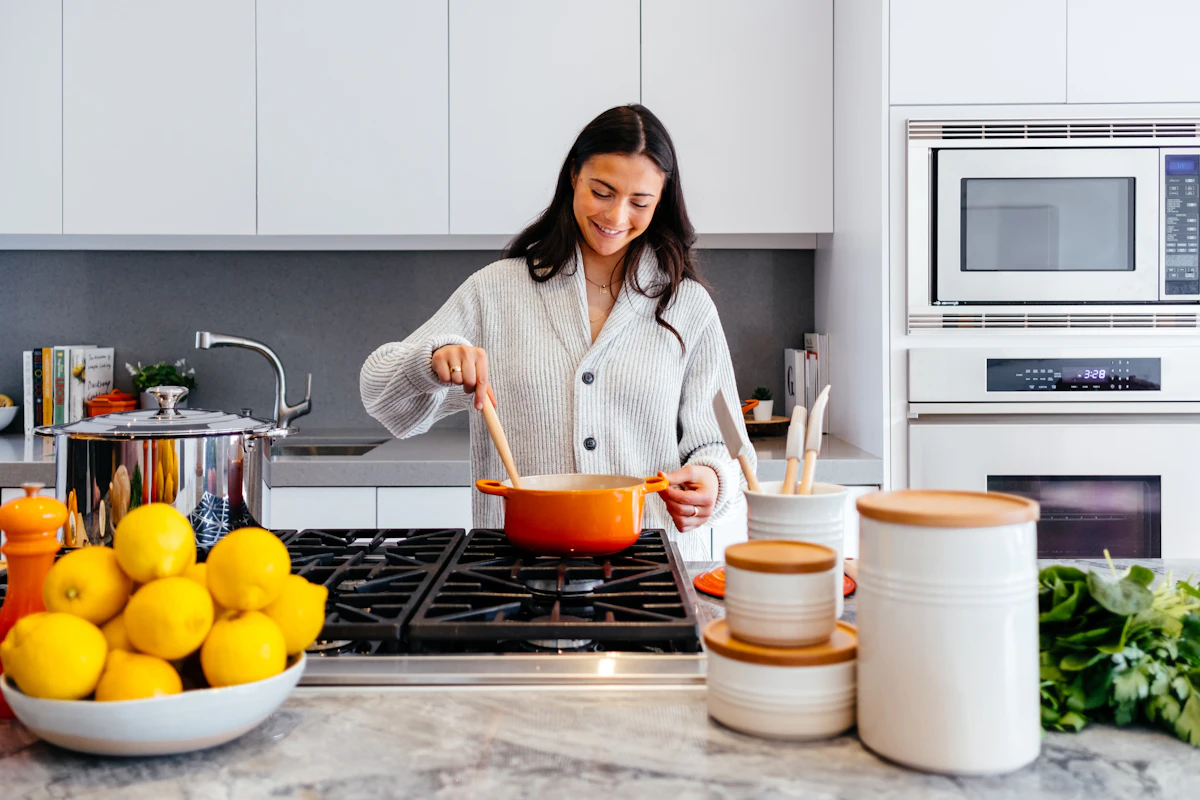
> **Image 1 Alt Text:** Aesthetic clean kitchen setup featuring non-toxic stainless steel cookware, glass food storage containers, and wooden utensils.
> **Image Generation Prompt (DALL-E / Midjourney):** *Editorial interior design photography of a bright, sunlit Scandinavian kitchen, open oak wood shelving with glass pantry jars, stainless steel cookware on a gas stove, potted herbs, 8k resolution.*
—
## Introduction: Why Your Kitchen May Be a Hidden Source of Endocrine Disruptors
When we embark on a clean living journey, we usually focus on organic food and clean skincare. However, the surfaces, pots, pans, and storage containers that touch our food every day play an equally critical role in our long-term health.
From **PFAS (“Forever Chemicals”)** lurking on traditional non-stick fry pans to **Microplastics & Phthalates** leaching out of plastic storage containers, standard kitchen products can contaminate nutritious meals with invisible chemical loads.
Transitioning to a non-toxic kitchen does not mean throwing everything away overnight. In this ultimate guide, we will break down the hidden toxins in modern kitchens, rank every cookware material on safety, and provide a prioritized **3-Stage Non-Toxic Kitchen Swap Blueprint**.
—
## Phase 1: The Cookware Safety Audit (Ranking Materials)
Not all cookware is created equal. Heat dramatically accelerates chemical leaching into food—especially when cooking acidic ingredients like tomatoes, citrus, or vinegar.
“`
[ COOKWARE SAFETY SPECTRUM ]
DANGEROUS MODERATE EXCEPTIONAL
┌───────────────┐ ┌───────────────┐ ┌────────────────────┐
│ Teflon/PTFE │ │ Sol-Gel Enamel│ │ 18/10 Stainless │
│ Traditional │──►│ 100% Ceramic │──►│ Pure Cast Iron │
│ Aluminum │ │ Coated Pans │ │ Glass / Carbon │
└───────────────┘ └───────────────┘ └────────────────────┘
“`
### 1. Traditional Non-Stick (Teflon / PTFE / PFOA) — *High Hazard*
* **The Risk:** Traditional non-stick coatings rely on polytetrafluoroethylene (PTFE). When heated above $450^\circ\text{F}$ ($230^\circ\text{C}$), PTFE degrades and releases toxic fumes linked to “Teflon flu” symptoms and thyroid disruption.
* **Verdict:** Replace immediately.
### 2. Sol-Gel Mineral Ceramic Coating — *Good Starter Option*
* **The Risk:** Silica-based ceramic coatings are free from PFAS, PFOA, and lead. However, cheap ceramic pans degrade after 6–12 months of high heat, exposing the raw underlying aluminum.
* **Verdict:** Safe, but requires low-to-medium heat and hand-washing.
### 3. 18/10 Stainless Steel — *The Professional Gold Standard*
* **The Safety:** 18/10 stainless steel (18% chromium, 10% nickel) is completely non-reactive, non-porous, and indestructible. It does not leach chemicals into food, regardless of cooking temperature.
* **Verdict:** Highly Recommended.
### 4. Raw Cast Iron & Enamelled Cast Iron — *Timeless Non-Toxic Champion*
* **The Safety:** Naturally non-stick when seasoned properly with organic neutral oils. Provides a natural boost of dietary iron while eliminating all synthetic chemicals.
* **Verdict:** Highly Recommended.
—
## Cookware Safety Comparison Matrix
| Material | Chemical Leaching Risk | Durability Score | Non-Stick Ease | Best Used For |
| :— | :— | :— | :— | :— |
| **Traditional PTFE / Teflon** | **Severe (PFAS Release)** | 1 / 5 | 5 / 5 | *Avoid Completely* |
| **Mineral Ceramic Coated** | Low (Zero PFAS) | 3 / 5 | 4 / 5 | Delicate Eggs & Fish |
| **18/10 Stainless Steel** | Zero | **5 / 5 (Lifetime)** | 3 / 5 | Searing, Sauteing, Soups |
| **Enamelled Cast Iron** | Zero | **5 / 5 (Lifetime)** | 4 / 5 | Dutch Ovens & Stews |
| **Pure Carbon Steel** | Zero | 5 / 5 | 4.5 / 5 | High-Heat Wok & Searing |
—
> **Image 2 Alt Text:** Glass meal prep containers and bamboo lid jars neatly arranged in a clean kitchen pantry.
> **Image Generation Prompt (DALL-E / Midjourney):** *Organized pantry flatlay featuring clear glass meal prep containers with bamboo lids, stainless steel water bottles, and natural linen dish towels, minimalist organic home aesthetic.*
—
## Phase 2: Ditching Kitchen Plastics (Food Storage & Prep)
Even “BPA-Free” plastics often utilize alternative bisphenols (like BPS or BPF) that exhibit similar estrogen-mimicking endocrine disruption.
### 3 Steps to Ditch Kitchen Microplastics:
1. **Swap Plastic Tupperware for Borosilicate Glass Containers:**
* Borosilicate glass withstands extreme temperature shifts (freezer to oven) without cracking. It never absorbs food odors, stains, or leaches microplastics when microwaved.
2. **Replace Plastic Cutting Boards with Solid Hardwood or Bamboo:**
* Research shows that chopping on plastic cutting boards exposes food to thousands of microplastic particles per year. Choose solid **Maple, Walnut, or Bamboo** boards naturally treated with organic beeswax.
3. **Switch to Stainless Steel or Glass Water Pitchers:**
* Eliminate plastic water filter carafes by switching to glass water dispensers or stainless steel under-sink filtration systems.
—
## Phase 3: Non-Toxic Dish Soap & Kitchen Cleaners
Standard dish soaps often contain synthetic fragrances, SLS (Sodium Lauryl Sulfate), and antibacterial agents like Triclosan that disrupt gut microbiome health when ingested via residual film on plates.
### What to Look For in Clean Kitchen Cleaners:
* **Fragrance-Free / 100% Essential Oil Scented:** Avoid generic *”Parfum”* on ingredient lists.
* **Plant-Derived Surfactants:** Look for Coco-Glucoside or Decyl Glucoside derived from coconut or corn.
* **Zero-Waste Solid Dish Soap Bars:** A great eco-friendly alternative that eliminates single-use plastic bottles entirely.
—
## The Prioritized 3-Stage Non-Toxic Swap Roadmap
“`
Stage 1: Immediate Free / Low-Cost Fixes
├── Never microwave food inside plastic containers.
├── Stop using metal utensils on non-stick pans (prevents scratching).
└── Throw away flaking or scratched Teflon pans.
Stage 2: Medium-Term Budget Upgrades ($20 – $80)
├── Replace plastic cutting boards with solid Maple wood.
├── Swap plastic storage containers for a 10-piece Glass Set.
└── Switch to a non-toxic, plant-based dish soap.
Stage 3: Lifetime Investment Upgrades ($100+)
├── Invest in a 3-Ply or 5-Ply 18/10 Stainless Steel Skillet.
└── Acquire a heavy-duty Enamelled Cast Iron Dutch Oven.
“`
—
## Frequently Asked Questions (FAQ)
### Is ceramic cookware completely non-toxic?
100% pure ceramic and quality mineral ceramic-coated cookware (free from heavy metals, lead, and cadmium) are non-toxic. Ensure you choose reputable clean brands that publish independent chemical safety lab tests.
### How do I stop food from sticking to stainless steel pans?
Use the **Leidenfrost Water Drop Test**: Preheat your stainless steel pan on medium heat for 2 minutes. Sprinkle a few drops of water onto the surface. If the drops glide across the pan like rolling marble beads, your pan is at the perfect temperature. Add oil, wait 10 seconds, then add your food.
### Are silicone kitchen utensils safe?
Food-grade platinum silicone is non-reactive and heat-stable up to $428^\circ\text{F}$ ($220^\circ\text{C}$). It is a safe non-toxic replacement for plastic spatulas and cooking spoons.
—
## Final Thoughts
Creating a non-toxic kitchen is a journey of conscious upgrades, not overnight perfection. By starting with high-impact swaps—like replacing scratched non-stick cookware with stainless steel and storing leftovers in glass—you protect your family’s health for years to come.
*Discover more organic home inspiration in our [Home & Living Journal Archive](https://thisizmarry.com/category/home-living/).*